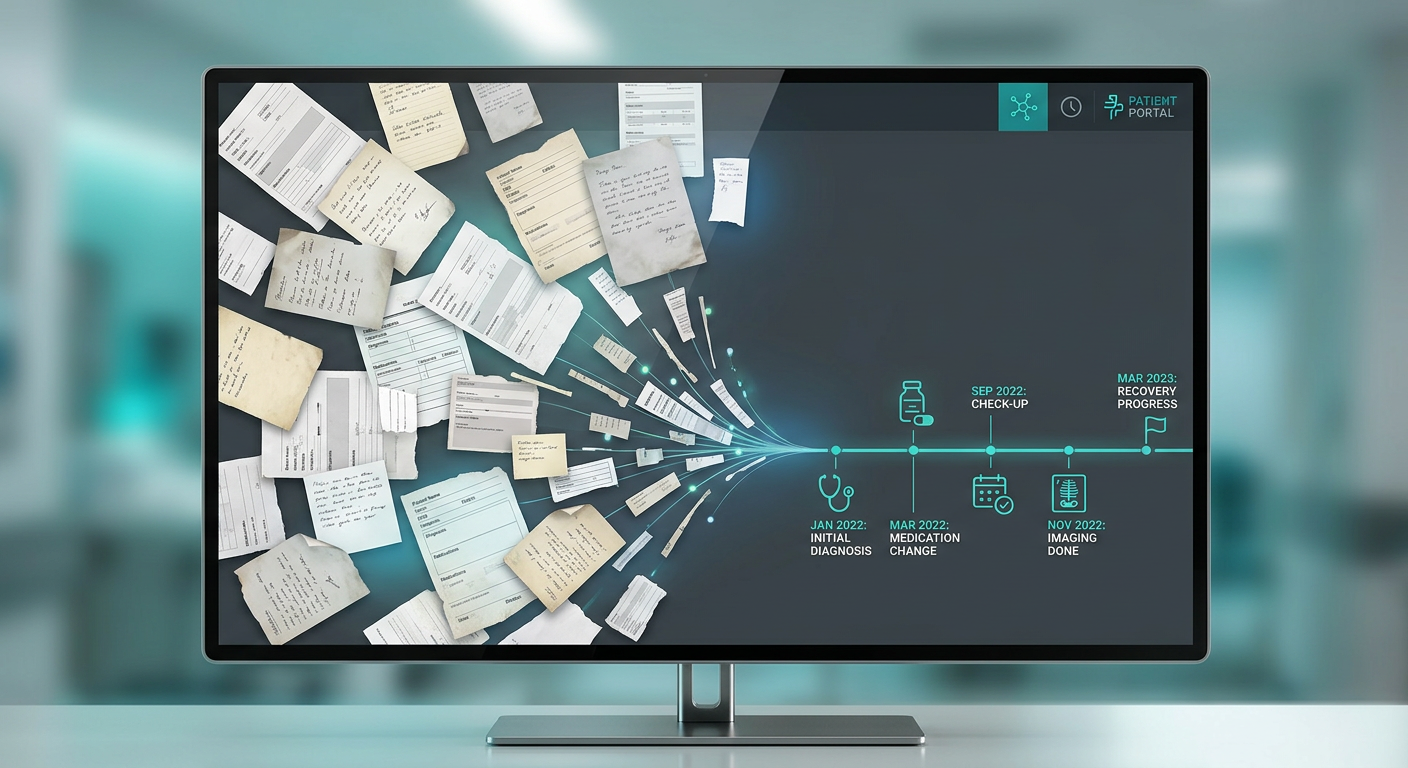
A patient walks into your clinic carrying a stack of discharge papers, a phone full of lab screenshots, and a memory of medications they think they're still taking. This is not an edge case. This is the current state of health records for millions of Americans, and the clinical picture you're working from is, at best, incomplete. The question is not whether fragmentation is a problem. It's how much that fragmentation is shaping decisions that should be based on the full story.
The Hidden Cost of Fragmented Health Data
Fragmented medical records are not a minor inconvenience. They represent a structural gap in care continuity that affects clinical judgment at every encounter. When a patient's history is spread across three health systems, two specialists, and a pharmacy benefit manager, no single provider has a complete view. Critical context gets missed: a prior adverse drug reaction buried in a 2019 hospitalization note, a specialist recommendation that never made it into the primary care chart, a trend in lab values that only becomes meaningful when viewed across 18 months. Every gap is a decision made without complete information. That has real consequences for diagnosis accuracy, medication safety, and care coordination across transitions.
Why Manual Chart Review Cannot Scale
The instinct is to solve the problem with more time and more staff. But that approach has a ceiling. Physicians already spend a significant portion of their workday on documentation and record review rather than direct patient care. Asking a clinician to manually reconcile records from multiple systems before every complex encounter is not a workflow solution. It is a workflow burden that compounds burnout and still leaves room for human error. The volume of health data generated per patient continues to grow with every EHR entry, remote monitoring data point, and wearable device transmission. Manual synthesis cannot keep pace with that volume, and the gaps it leaves are not random. They tend to cluster around the patients with the most complex histories and the highest clinical risk.
What AI Medical-Record Summaries Actually Do
AI medical-record summaries work by ingesting structured and unstructured data from across a patient's care history and organizing it into a single, coherent clinical narrative. That means pulling from discharge summaries, lab results, imaging reports, medication histories, specialist notes, and remote monitoring feeds, then surfacing what is clinically relevant in a format that supports fast, confident decision-making. The output is not a data dump. It is a structured summary that highlights active conditions, medication reconciliation flags, care gaps, and longitudinal trends. For a clinician preparing for a complex visit, that means arriving with context. For a patient navigating their own care, it means finally understanding the full arc of their health story in plain language.
The Continuity Argument for Providers and Health Systems
For health systems, the value of unified records extends beyond the individual encounter. Structured, AI-organized patient data supports population health management, risk stratification, and quality reporting. When every patient record tells a complete story, the aggregate view becomes far more actionable. Care teams can identify which patients are overdue for follow-up, which transitions of care are producing readmissions, and where chronic condition management is breaking down between visits. Continuity is not just a clinical virtue. It is an operational advantage that reduces duplicative testing, prevents avoidable adverse events, and supports the kind of coordinated care that value-based contracts require. AI medical-record summaries are a foundational tool for delivering that continuity at scale.
What Patients and Caregivers Gain From One Organized View
The benefits of unified records are not reserved for the clinical side of the encounter. Patients and caregivers who have access to a clear, organized summary of their health history are better equipped to participate in shared decision-making, manage chronic conditions between visits, and communicate accurately with new providers. For a caregiver managing the care of an aging parent across multiple specialties, a single organized health summary is the difference between coordination and chaos. For a patient preparing for a surgical consult, it means walking in with documentation that is complete rather than approximate. Clarity is not a luxury feature. It is what makes informed consent and patient engagement possible in a meaningful way.
The fragmented record is not the patient's fault, and it is not the clinician's fault. It is a systemic problem that requires a structural solution. AI medical-record summaries do not replace clinical judgment. They give that judgment the full picture it needs to be effective. The real question is how many encounters should happen without that clarity before it becomes standard.
See how MediClarity gives clinicians and patients one organized view of the full health story. Visit mediclarity.ai to learn more or request a demo.